
For two days, the National Autonomous University of Mexico (UNAM) hosted an International Bilingual Symposium organized and carried out through the collaboration of the Center for Research on North America (CISAN) at UNAM and the Global Research Forum on Diasporas and Transnationalism (GRFDT) in India. This collaboration between the two institutions resulted from academic ties that researchers on both sides had strengthened over the previous three years, leading to truly remarkable results.
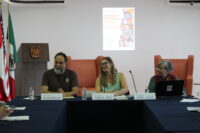
On September 17th and 18th, 2026, participants once again exchanged perspectives on international migration from Indian and Mexican perspectives, while also incorporating insights from other countries. The International Bilingual Symposium was held within the framework and under the sponsorship of PAPIIT Project IN302324, “Communication and Diaspora Diplomacy: Perspectives from Reception Contexts in the Americas, Europe, and Asia”, and the “Seminar of Diaspora Diplomacy” (SDD), both at UNAM. Prof. Camelia Tigau, coordinator of the PAPIIT Project and head of the SDD, also played a central role in organizing the symposium. She noted that bringing together experts on diasporas, international migration and communication marked the culmination of the PAPIIT Project. The symposium therefore provided an opportunity to bring together the project’s main achievements and celebrate its outstanding results.
On the GRFDT side, Professor Amba Pande and Dr Iman Ahmed joined in person, while Professor Binod Khadria and Sadananda Sahoo participated online. After the inauguration by CISAN´s director, Juan Carlos Barrón Pastor, also a member of the project, Prof. Pande from Jawaharlal Nehru University delivered a stellar address on “Diaspora Diplomacy in India and the World”. She provided a concise yet comprehensive characterisation of the Indian diaspora worldwide and highlighted the diplomatic resources it draws on internationally, as well as its sheer size and global dispersal, including its presence in North America. She also examined the mechanisms developed in cooperation with the Indian government to increase its impact both abroad and within India. On the study of the Indian diaspora, Silvia Núñez, researcher at CISAN, offered several insightful observations. Núñez drew indirect parallels between Indian and Mexican migration movements, as well as broader migration patterns across the hemisphere. She emphasised the lessons that could be drawn from the experiences of Indian migrants and how they could enrich dynamics in North America.
The sessions that followed highlighted the work carried out through the PAPIIT Project, both within and beyond UNAM. The program also included a presentation of Migration and the Rise of the United States, edited by Pande and Tigau. Several of the book’s authors participated in the discussion, offering different perspectives, encouraging the audience to read the book. Dr. María Cristina Hall, a CISAN researcher, explained that her presentation consisted of preliminary findings from ongoing research that is currently under consideration for publication. Her contribution, “Recasting Anti-Immigrant Narratives in the United States,” brings together five migrant experiences whose narratives express their feelings and transnational resistance to an official discourse that fails to reflect reality. These distorted narratives promoted by Donald Trump’s government are challenged by genuine artistic expressions.
Another significant contribution to the debate on international mobility was CISAN’s decision to devote an entire issue of its magazine to the subject. Issue 127 of Voices of Mexico featured a range of perspectives on recent trends in international migration in North America. The magazine’s editorial coordinator, Prof. Graciela Martínez-Zalce, a researcher at CISAN, provided an overview of its contents and discussed the significance of migration as a crucial issue in the region in recent years. The issue includes experiences from the three countries that make up the region and fall within CISAN’s field of study.
Likewise, CISAN’s Academic Secretary, Dr. Roberto Zepeda Martínez, described his contribution. He explained that his analytical focus on paradiplomacy had been applied to migration governance in North America. Drawing on the concept of global governance and his specialization in paradiplomacy, he analyzed the many actors (foreign, national, and local) who interact in shaping how mobility is managed throughout the region.
At the end of the day, the performance Apegos (Com)partidos was presented, a moving artistic work that addresses the human and emotional realities, as well as the exploitation, behind migration to rural areas of the United States and Canada. The performance is inspired by the work of journalist Kau Sirenio (Jornaleros migrantes. Explotación transnacional), directed by Omar Guadarrama Aguirre, promoted by Tigau, and performed by CISAN researcher Dr. Aaraón Díaz Mendiburo and dancer Adrián Mejía Valencia.
The second day of activities started with a discussion of another collaborative publication by the group of researchers, the book Diplomacia de las movilidades humanas: activismo y comunicación responsable en las Américas, Europa y Asia, coordinated by Camelia Tigau, Roberto Zepeda, and Antonio Alejo. The book brings together authors from India, Mexico, Spain, and the US.
Dr. Sadananda Sahoo of Indira Gandhi National Open University and Dr. Abhishek Yadav of the GRFDT presented their work, “Diaspora Activism and India’s Soft Power: The North American Connect”. Sahoo spoke of the importance of India’s diaspora in the United States and its role in institutionalizing bilateral relations. Yadav added to the presentation, emphasizing that a diaspora is built rather than inherited. He also explained how the Indian diaspora leveraged their soft power, while also contributing to India’s integration through firm domestic policies and efforts to advance development.
The GRFDT also had to be acknowledged for its commitment to and impact on the study of human mobility. Its president, Dr. Binod Khadria, a distinguished scholar and internationally recognized public official who had visited CISAN in connection with the PAPIIT Project in 2025, provided a broader overview of the organization’s work. He acknowledged the challenges involved in bringing together migration experts and examining migration flows worldwide, particularly those involving India. To illustrate the seriousness with which his group approaches student training and takes firm positions on global migration, he revisited concepts such as South-South cooperation, expressing concern that these concepts are not always fully understood in diplomatic circles, even though they are crucial to shaping policies on human mobility. He concluded by expressing his pride in the collaboration between the GRFDT and CISAN, particularly in the work he has done with Tigau.
The second keynote lecture followed. Dr. Iman Ahmed, a physician by training and an activist by vocation, presented the case of Sudanese doctors in exile who remain concerned about Sudan’s health situation. She prepared a study with Dr. Sara Ibrahim Abdelgalil, which highlighted migrants’ narratives as a way of documenting and sharing experiences across geographical, cultural, and generational boundaries, with the aim of transforming conditions of poverty in this African country on the Red Sea. Ahmed explained how successive waves of doctors fled Sudan because of military repression, eventually reaching almost every part of the world.
Before the Symposium came to a close, it was important to acknowledge one of the PAPIIT Project’s most significant legacies. In addition to training students and organizing public events to foster debate on human mobility, the project also included an initiative to promote communication with and about migrants. In this regard, CODDAN-Lab (short for Laboratory of Analysis of Communication on Diaspora Diplomacy in North America) represents an important part of the project’s legacy. In particular, Everest Landa, a valued member of both the PAPIIT Project and the SDD, traced the development of the podcast Y sin embargo, se mueve a title that conveys a powerful message: despite the global regulations intended to govern human mobility, “and yet it moves.” This idea also underpins the podcast’s productions. Clearly, the podcast is a collaborative endeavor, and its results in communicating issues related to migration suggest that collaboration between UNAM and GRFDT deserves to be continued.
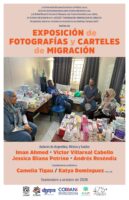
Finally, once the program had concluded, the Symposium was formally brought to a close. Participants could look back with satisfaction on having fulfilled the Symposium’s mission and take stock of the outcomes of three intensive years of work on diaspora communication and diplomacy across several countries. The closing was an emotional occasion for all participants, both those attending in person and those joining remotely, particularly Tigau and Zepeda, who delivered the closing remarks. As part of the academic and public farewell to the PAPIIT Project, participants were also warmly invited to visit a concurrent exhibition entitled Posters on Migration and Mobility, featuring works by doctoral students from the Migration and Mobility in Times of Crisis Seminar (PPCPYS, UNAM): Victor Villarreal Cabello, Jessica Petrino, and Andrés Reséndiz Ponce. The exhibition also included photographs of Sudan by Iman Ahmed.
By Dagoberto González, Academic Technician at CISAN, UNAM